
Turbo Repair vs. Replacement: Which Option Makes the Most Sense?
The Question Almost Every Turbo Owner Eventually Asks
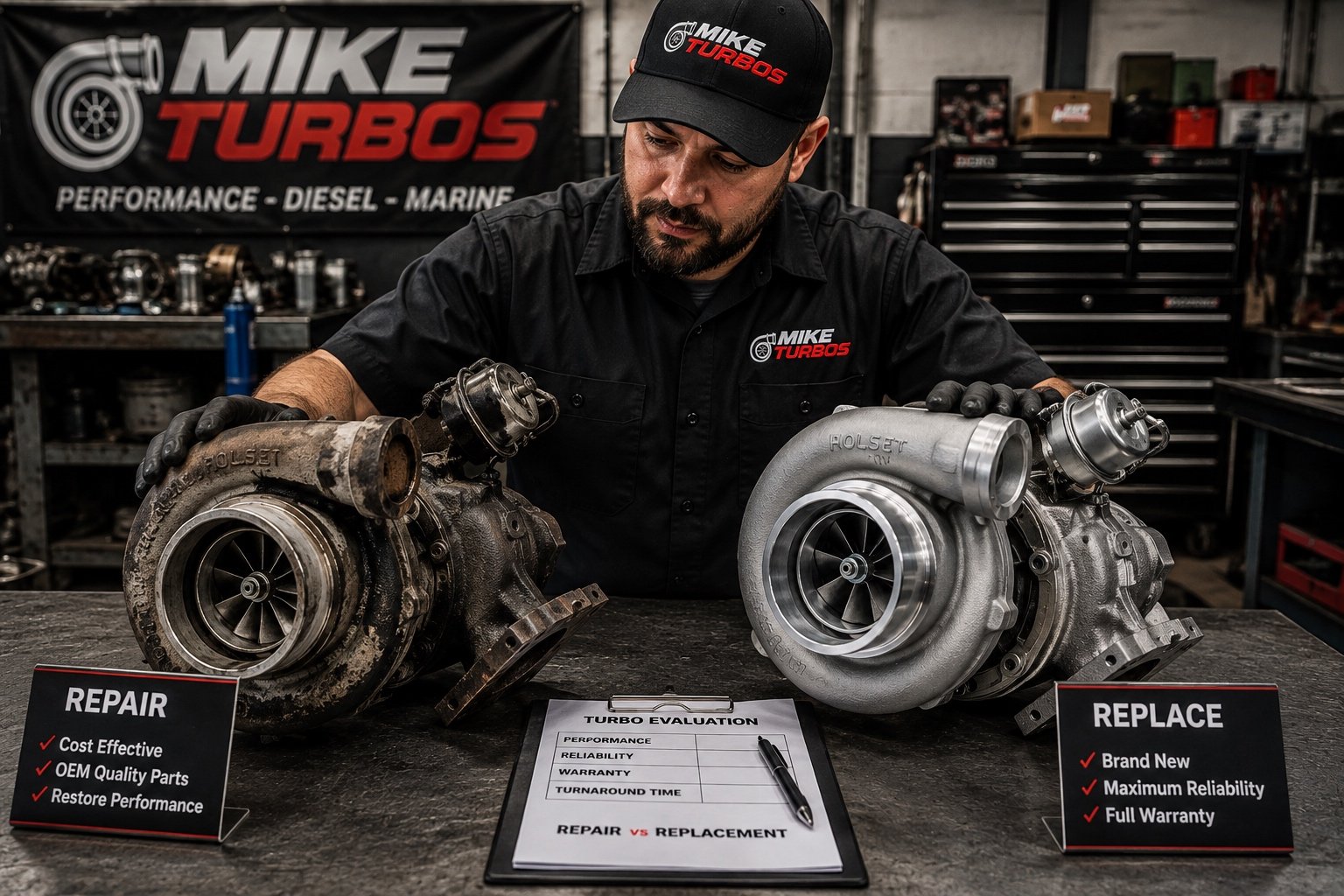
Your turbocharger has a problem.
Now comes the expensive question:
Should you repair it or replace it?
The internet will give you plenty of simple answers.
“Always buy new.”
“Never buy new.”
“Just rebuild it.”
“Rebuilt turbos never last.”
None of those blanket statements is particularly useful.
The correct answer depends on the condition of the turbocharger, the damage it has suffered, the application, parts availability, downtime requirements and—most importantly—the reason the problem occurred in the first place.
What Does Turbo Repair Mean?
The term “turbo repair” can describe several different levels of service.
A turbo may need:
- Inspection and diagnosis
- Actuator repair
- Component replacement
- Bearing and seal service
- Cleaning
- Rebalancing
- A complete rebuild
That is why comparing two “turbo repair” prices without knowing what is included can be misleading.
A professional turbocharger rebuild should begin with disassembly and inspection.
Mike Turbo’s published repair process includes inspection of the shaft and housings, bearings, seals and rings, replacement of service components, cleaning and balancing of rotating parts.
That inspection tells you whether rebuilding actually makes sense.
When Repair or Rebuilding May Be the Better Choice
A turbocharger can often be a strong candidate for rebuilding when its important reusable components remain in good condition.
For example, a rebuild may make economic sense when:
- The housings remain usable
- The rotating hard parts are within acceptable condition
- Replacement components are available
- The turbo is expensive to replace
- The application is older or difficult to source
- The original turbo is valuable enough to preserve
Heavy-duty, industrial and marine applications can be particularly interesting candidates because some replacement units are costly or difficult to locate.
The key is inspection.
You cannot accurately determine the internal condition of a turbocharger simply by looking at the outside.
When Replacement May Make More Sense
There are also situations where rebuilding a damaged turbo is not the best investment.
Replacement may make more sense when:
- Major housings are cracked or severely damaged
- Compressor or turbine components have suffered extensive damage
- The shaft or bearing housing is badly damaged
- Too many hard parts must be replaced
- Replacement parts are unavailable
- The total rebuild cost approaches the cost of a quality replacement
- Downtime makes waiting for a specialized rebuild impractical
The objective should not be to rebuild every turbo.
It should be to choose the most sensible solution.
New vs. Rebuilt Is Not the Only Question
Many consumers focus entirely on whether the turbo is “new” or “rebuilt.”
Quality matters more than the label alone.
A poorly selected new turbocharger installed onto an engine with unresolved problems can fail.
A properly inspected and professionally rebuilt turbo can provide excellent service in an appropriate application.
The questions should be:
- Is it the correct turbo?
- Who built or repaired it?
- What components were inspected?
- What parts were replaced?
- Was the rotating assembly properly balanced?
- What warranty or support is provided?
- Was the cause of the previous failure corrected?
Why Balancing Matters in a Rebuild
Turbochargers rotate at extremely high speed.
That makes rotating-component condition and balance extremely important.
Mike Turbo includes balancing of rotating components and a balancing report as part of its published rebuild service.
If you are comparing rebuilders, ask what the repair process actually includes.
Price alone does not explain quality.
The Most Important Question: Why Did the Turbo Fail?
This is where consumers can save themselves significant money.
Suppose you replace a failed turbocharger but never determine why it failed.
If the original problem was contaminated oil, insufficient lubrication, a blocked oil line, foreign-object damage or another engine-system fault, the replacement turbo may be exposed to exactly the same condition.
A new turbo does not repair a dirty lubrication system.
A rebuilt turbo does not repair a blocked air filter.
A replacement turbo does not repair an unresolved engine problem.
Fix the cause before installing the solution.
Heavy-Duty Truck Owners Need to Consider Downtime
For an owner-operator or fleet manager, the decision is not purely mechanical.
Downtime costs money.
Suppose rebuilding the original turbo is less expensive but requires the truck to remain out of service longer.
In that specific situation, a readily available replacement unit may make more business sense.
In another situation, rebuilding an expensive heavy-duty turbo may save substantial money without materially increasing downtime.
The decision should consider:
- Repair cost
- Replacement cost
- Availability
- Shipping time
- Labor
- Truck downtime
- Expected reliability
- Warranty
- Remaining service life of the vehicle
That is a business calculation as well as a repair decision.
What About Older Engines?
Older does not automatically mean obsolete.
Mike Turbo stocks and services a broad range of turbochargers and allows customers to ship turbochargers to its Florida location for inspection and repair.
For older heavy-duty, industrial or marine equipment, rebuilding the original turbocharger may sometimes be preferable to adapting an incorrect replacement.
The specific part number and engine application should guide the decision.
What Should You Ask a Turbo Shop?
Before approving a repair or replacement, ask:
- What actually failed?
- What caused the failure?
- Can my existing turbo be rebuilt?
- Which hard parts are reusable?
- Which parts need replacement?
- Is the rotating assembly balanced?
- What is the price difference between rebuilding and replacement?
- Is the replacement unit new, rebuilt or remanufactured?
- Is the exact fitment confirmed?
- What should be corrected on the engine before installation?
A good turbo specialist should be able to explain the recommendation.
The Bottom Line
Repair is not automatically better.
Replacement is not automatically better.
The best option is the one that makes sense after the turbocharger and the engine system have been properly evaluated.
Mike Turbo Inc provides turbocharger diagnosis, rebuilding, balancing, actuator service, upgrades and replacement solutions for a wide range of applications.
Do not buy a turbo because someone guessed. Inspect the problem, understand the damage and spend the money once.